


 5397 0200 1783 0041
What does Moldova offer the world today? / Moldova


- Main Conclusion
- The main countries importing goods from Moldova are:
- Products that Moldova sells on the global market:
- Moldova’s purchases and sales, 2022–2025
- Product Categories (Imports) Purchased by Moldova in 2025
- Top 5 Product Categories Moldova Exports to Europe
- Moldova is actively increasing its sales in European countries
- Imports – Exports. Moldova – Europe
- Success Stories
- A Comparison of Moldova with Neighboring Countries: Export Structure
- What does this mean for Moldova?
- Requirements of Investor Companies
- The main idea
- List of business tasks
- FAQ
The purpose of this article is to highlight what Moldova is currently selling on global markets, what it is purchasing from abroad, and what conclusions can be drawn today about the country’s economic development.
📦 Moldova exported the following goods: $3.78 billion (2025)
🛒 Moldova purchased the following goods: $10.92 billion (2025)
⚖️ Difference: $7 billion
For example, today Moldova sells $1 worth of goods and buys $2.9 worth of goods.
Where does Moldova get the difference from?
- Remittances from migrant workers remain the main source of funds to bridge the gap. In 2025, the volume of remittances reached $1,66 billion
- Financial assistance and grants from the European Union for modernization. In 2025, this amounted to $331 million
- Exports of services (IT, logistics, transportation, telecommunications, tourism) – the sale (export) of services brings foreign currency into the country and partially offsets the trade deficit in goods. Moldova’s exports of services (2025) have reached $2,74 billion
- Loans – from the government, banks, and businesses – are raised from external sources. (The government borrows funds to build roads and support the budget. Businesses take out loans to purchase equipment and promote their products on the market. Banks raise funds from abroad.) In 2025, Moldova mastered $710 million
- Foreign investment – when a foreign company builds a factory or establishes a production facility in Moldova, it brings foreign currency into the country, which is used to purchase imported equipment and materials. By the end of 2025, Moldova had attracted $468 million foreign direct investment (FDI)
The largest investor countries
- Cyprus
- The Netherlands
- Romania
- United Kingdom
- Bulgaria
Which industries are they investing in?
The largest share of accumulated investments is accounted for by:
- the financial sector;
- wholesale and retail trade;
- manufacturing;
- IT and telecommunications;
- real estate;
- transportation and logistics.
Main Conclusion
A trade deficit does not in itself mean that a country is “short on money.” It means that imports are paid for not only by exports of goods, but also by other sources of foreign currency.
This is precisely why Moldova can import significantly more goods than it exports without triggering an immediate economic crisis. However, if the inflow of remittances, investments, and external financing were to decline significantly, it would become much more difficult to maintain this level of imports.
The main countries importing goods from Moldova are:
| Top-10 Position | Buyer's country | Exports, $ million | Share of the total volume |
|---|---|---|---|
| 🥇 1 | 🇷🇴 Romania | 1 096 | 29,0% |
| 🥈 2 | 🇹🇷 Turkey | 376 | 9,9% |
| 🥉 3 | 🇮🇹 Italy | 349 | 9,2% |
| 4 | 🇨🇿 Czech | 311 | 8,2% |
| 5 | 🇺🇦 Ukraine | 300 | 7,9% |
| 6 | 🇩🇪 Germany | 150 | 4,0% |
| 7 | 🇭🇺 Hungary | 125 | 3,3% |
| 8 | 🇵🇱 Poland | 113 | 3,0% |
| 9 | 🇷🇺 Russia | 107 | 2,8% |
| 10 | 🇬🇷 Greece | 81 | 2,2% |
| 11 | 🇧🇾 Belarus | 76 | 2,0% |
| 12 | 🇳🇱 Netherlands | 70 | 1,8% |
| 13 | 🇫🇷 France | 54 | 1,4% |
| 14 | 🇺🇸 USA | 50 | 1,3% |
| 15 | 🇨🇭 Switzerland | 41 | 1,1% |
Products that Moldova sells on the global market:
| Top Rank | Product categories | Sales (in millions of dollars) | Share of the total volume |
|---|---|---|---|
| 1 | Oilseeds (sunflower, rapeseed, soybeans, etc.) | 590,5 | 17,32% |
| 2 | Electrical products (cables, wiring, plastic parts, etc.) | 581,8 | 17,06% |
| 3 | Fruits, vegetables, berries, nuts | 321,6 | 9,43% |
| 4 | Grains | 265,7 | 7,79% |
| 5 | Wine and beverages | 255,3 | 7,49% |
| 6 | Clothing and fabric | 203,8 | 5,98% |
| 7 | Furniture and parts | 139,0 | 4,08% |
| 8 | Vegetable Oils and fats | 128,8 | 3,78% |
| 9 | Glass and glass products | 112,6 | 3,30% |
| 10 | Preserved and processed fruit and vegetable products (canned goods, jarred goods, concentrates) | 101,3 | 2,97% |
| 11 | Chemical industry (varnishes, paints, detergents, household chemicals, cosmetics) | 100,0 | 2,93% |
| 12 | Knitwear | 92,7 | 2,72% |
| 13 | Mechanical equipment (pumps, filters, gearboxes, shafts) | 86,4 | 2,53% |
| 14 | Mineral products (cement, lime, gypsum, and other building materials) | 70,0 | 2,05% |
| 15 | Steel products (structures, staircases, railings, gates, shelving) | 59,1 | 1,73% |
| 16 | Pharmaceutical products | 57,9 | 1,70% |
| 17 | Packaging (wooden containers, pallets, boxes, paper and cardboard products, plastic packaging) | 50,0 | 1,47% |
| 18 | Other product categories (meat products, eggs, sugar, pasta, cookies, etc.) | 40,0 | 1,17% |
| 19 | Fuel and petroleum products (re-export; purchased in Romania - stored in Moldova - sold in Ukraine) | 153,6 | 4,50% |
Moldova’s purchases and sales, 2022–2025
This means that every year, significantly more money leaves the country to purchase foreign goods than comes in from the sale of domestic goods.
It is important to understand that imports include:
- equipment for businesses;
- automobiles;
- medicines;
- fuel and gas;
- industrial raw materials.
If imports (purchases) of machine tools and equipment are increasing, this may indicate investment in the economy. If, on the other hand, imports of consumer goods are the main drivers of growth and exports are not keeping pace, this exacerbates the imbalance.
Product Categories (Imports) Purchased by Moldova in 2025
| Rank on Top | Product categories | Purchases $ (import) | Share of the total volume |
|---|---|---|---|
| 1 | Petroleum products, natural gas, and other energy sources | $2,44 млрд | 22,3% |
| 2 | Electrical Equipment and Electrical Engineering | $999 млн | 9,2% |
| 3 | Cars and other vehicles | $946 млн | 8,7% |
| 4 | Industrial equipment and machinery | $862 млн | 7,9% |
| 5 | Plastics and plastic products | $398 млн | 3,6% |
| 6 | Medicines and pharmaceutical products | $357 млн | 3,3% |
| 7 | Ferrous metals | $223 млн | 2,0% |
| 8 | Ferrous metal products | $211 млн | 1,9% |
| 9 | Organic Chemical Products | $190 млн | 1,7% |
| 10 | Foodstuffs and prepared foods | $180 млн | 1,6% |
Based on this data, several meaningful conclusions can be drawn:
- Moldova remains dependent on energy imports.
The largest category of imports is fuel, petroleum products, and natural gas. This indicates the country’s high dependence on foreign energy suppliers. - The economy is actively investing in equipment upgrades.
Large volumes of imports of machinery, industrial equipment, and electrical equipment indicate the modernization of enterprises, the expansion of production, and the construction of new facilities. - The automotive market remains very active.
Significant automobile imports reflect high demand for vehicles from both consumers and businesses. - Industry relies heavily on imported raw materials.
The high volume of imports of plastics, metals, and products made from them indicates that many Moldovan manufacturers use foreign raw materials and components for further production and sale. - The country remains a net importer.
Imports significantly exceed exports, and there is a high dependence on foreign supplies of goods and materials.
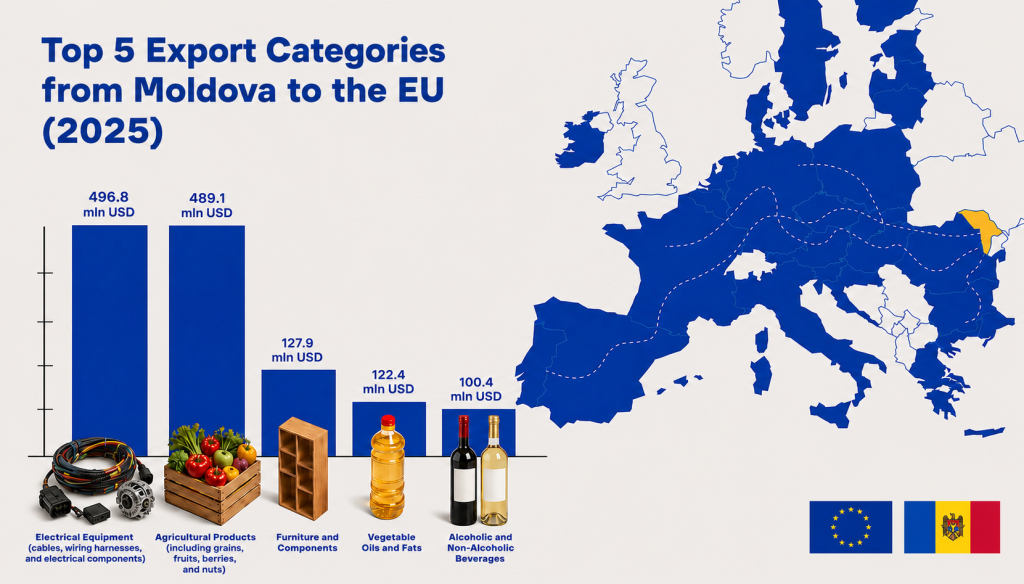
Top 5 Product Categories Moldova Exports to Europe
| Rank on Top | Product categories | Exports to the EU, in millions of dollars |
|---|---|---|
| 1 | Electrical equipment (cables, wires, and other components) | 496,80 |
| 2 | Agricultural products (including grains, berries, and nuts) | 489,1 |
| 3 | Furniture and components | 127,0 |
| 4 | Vegetable oils and fats | 122,4 |
| 5 | Alcoholic and non-alcoholic beverages | 100,4 |
Moldova is actively increasing its sales in European countries
As an example, the data on exports and imports from the Netherlands is shown – the Netherlands has consistently increased its sales to Moldova over the past five years.
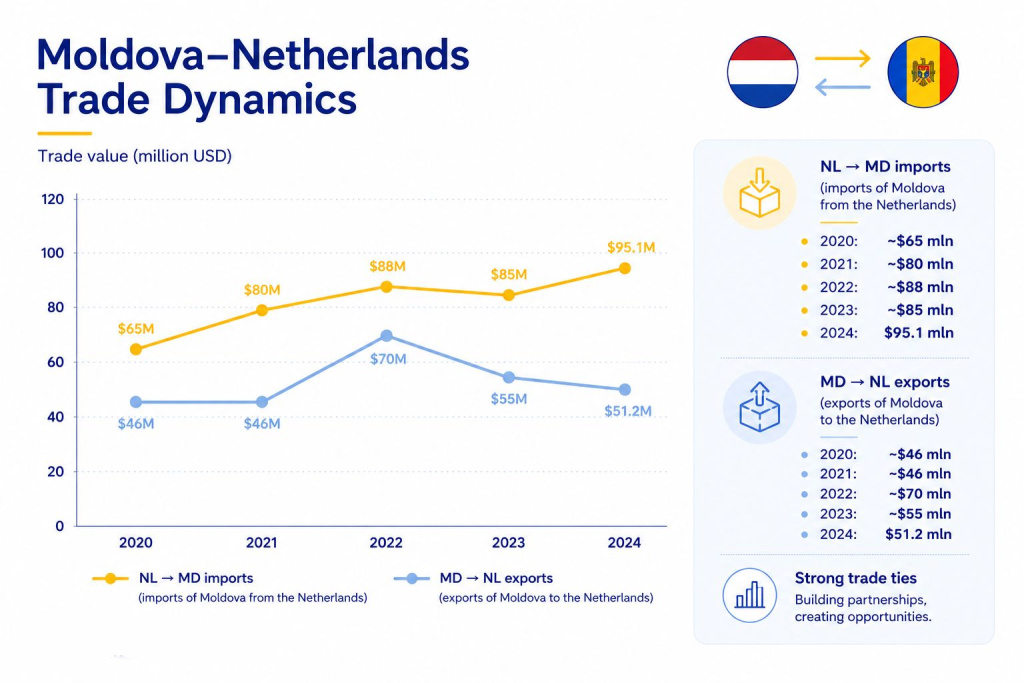
The trade balance between Moldova and the Netherlands remains negative.
- Exports: $51.2 million
- Imports: $95.1 million
- Deficit: $43.9 million
Moldova’s main exports to the Netherlands:
- Electrical converters – $5.8 million
- Grapes and plums – $5.7 million
- Furniture and furnishings – $5.0 million
- Wine – $4.4 million
- Seeds – $3.9 million
- Walnuts – $2.2 million
Major export goods from the Netherlands to Moldova:
- Tractors – $7.9 million
- Greenhouse plants – $4.9 million
- Natural gas – $3.8 million
- Flower bulbs – $2.8 million
- Dormant bulbs and tubers – $2.7 million
- Cut flowers – $2.6 million
Imports – Exports. Moldova – Europe
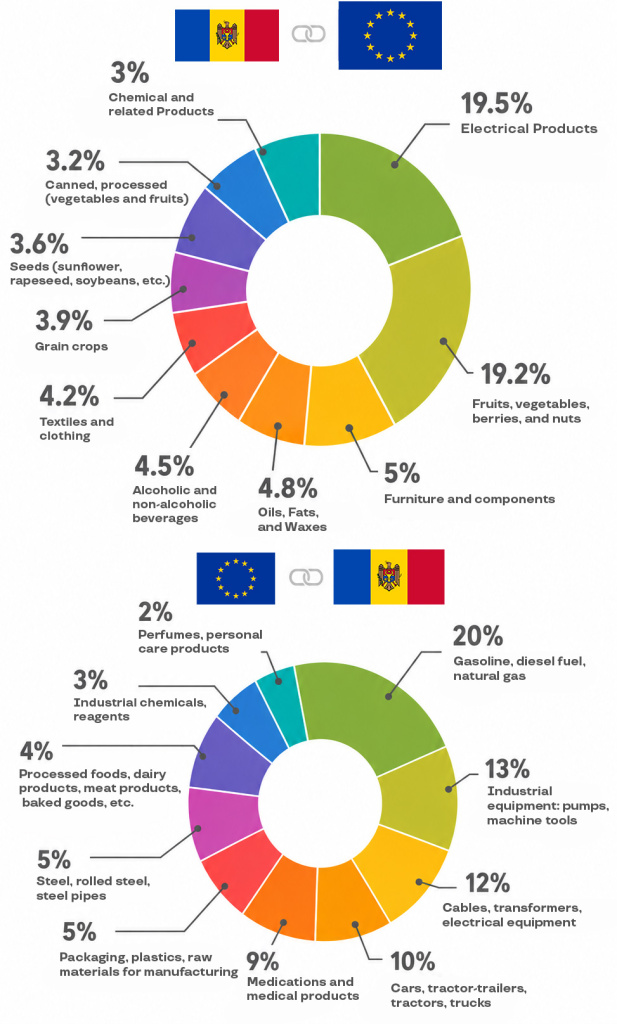
| Moldova Buys (Imports) from Europe | Moldova Sells (Exports) to Europe |
|---|---|
| Industrial equipment | Electrical Products |
| Machines | Fruits and Vegetables |
| Cars | Furniture and accessories |
| Electronics | Wine and beverages |
| Medical equipment | Nuts |
| Agricultural chemistry | Seeds |
| Medications | Textiles |
| Raw materials for packaging production | Canned foods, processed vegetables, and fruits |
| Perfumes, personal care products | Mineral products (cement, lime, gypsum, and other materials) |
Moldova exports most of its goods to Europe
- Automotive parts and components. These are primarily products manufactured under contract for the European automotive industry.
- Fruits, vegetables, berries, and nuts.
The structure of Moldova’s economy currently differs from that of European countries. This is a typical pattern of trade between a developing and a developed economy.
Why does this happen?
For decades, Europe has specialized in high-value-added products.
The agricultural sector is one of the most developed sectors of Moldova’s economy, thanks to its favorable climate and accumulated experience.
The difference lies not so much in trade volumes as in value added.
For example:
- A tractor costing $120,000 may include engines, electronics, software, and engineering;
- Several metric tons of apples costing $120,000 consist mainly of raw materials with a relatively small profit margin.
Therefore, in order to purchase a single modern machine, it is sometimes necessary to export dozens of metric tons of agricultural products.
Moldova is currently striving to take on more outsourcing projects for the production of small parts and components for large corporations. This sector offers much greater stability and predictability than the agricultural sector, where weather conditions play a major role. There is an opportunity to enter into long-term contracts, ensure stable production capacity utilization, and reduce dependence on climate fluctuations. This leads to the development of logistics infrastructure: modern complexes, distribution centers, and transportation hubs.
This is already happening in practice. There are companies in Moldova that produce:
- automotive wiring harnesses;
- electronic components;
- plastic parts;
- metal components;
- automotive seats and interior components;
- textile products for the automotive industry.
The problem in Moldova is that the share of high-tech products remains relatively small for now.
From a long-term perspective, the key challenge for Moldova is – the goal is not so much to increase the volume of exports as to increase the share of high-value-added goods and services. This is precisely what enables countries to increase household incomes more quickly and reduce their trade deficits.
Brands offering finished products rather than raw materials are expected to enter the Moldovan market.
❌ apples → ✅ concentrates, baby food, snacks;
❌ grapes → ✅ premium wines, brandy;
❌ grain → ✅ prepared foods;
❌ just programmers → ✅ in-house SaaS products, services, websites, apps
Success Stories
Many countries have already gone through the transition from agrarian production → technology-based production → the development of their own ideas and technologies. Let’s look at a few examples.
🇰🇷 South Korea
The 1960s
- fish;
- rice;
- fruits and vegetables;
- textiles;
- everyday goods.
Today
- semiconductors;
- automobiles;
- smartphones;
- shipbuilding;
- consumer electronics;
- music;
- movies;
- cosmetics;
Result:
- Per capita GDP rose from less than $200 to more than $35,000.
Of course, South Korea’s experience cannot be fully applied to Moldova. The two countries differ in market size, geography, resources, and political history. However, the general logic behind the growth of value added remains the same.
🇮🇪 Ireland
As recently as 40–50 years ago, the economy relied heavily on agriculture.
The country has successfully transitioned from exporting raw materials to exporting technology.
Today, the following are being exported:
- software;
- pharmaceuticals;
- medical equipment;
- IT services.
Major international companies operate in the country, and exports of high-value-added products have become one of the drivers of economic growth.
🇸🇰 Slovakia
It has virtually no natural resources of its own.
The country used to export (sell) what farmers grew in their orchards and fields; after the reforms, the country began exporting what was produced on assembly lines in factories.
Today, the country is one of the world’s leading producers of automobiles per capita.
Exported by:
- automobiles;
- engines;
- transmissions;
- automotive components.
After gaining independence in 1993, Slovakia:
- lowered taxes;
- simplified the process of starting a business;
- established industrial parks;
- offered tax incentives to investors;
- actively attracted Western companies.
As a result, the country attracted the largest manufacturers:
- Volkswagen
- Kia
- PSA Peugeot Citroën
- Jaguar Land Rover
- Other brands.
History shows that a country’s wealth is determined not only by the amount of natural resources it has, but also, to a large extent, by its ability to produce products that are in demand and purchased around the world.
A Comparison of Moldova with Neighboring Countries: Export Structure
To understand Moldova’s current situation, it is important to compare its export model with that of its closest neighbors in the EU and the region: Romania, Poland, Hungary, Slovakia, and Lithuania.
These countries were also previously in the process of transitioning from agrarian to industrial and high-tech economies. In turn, these countries are now at various stages of industrial development.
Differences by level:
- 🇲🇩 Moldova → an agrarian-industrial model with the emergence of contract farming
- 🇷🇴 Romania → a fully-fledged industrial economy
- 🇵🇱 Poland → a major industrial exporter in the EU
- 🇸🇰 Slovakia → a world-class, highly specialized automotive industry
- 🇭🇺 Hungary → a highly industrialized manufacturing hub
- 🇱🇹 Lithuania → Logistics + Processing + Industrial Niches
Key sectors that drove the industrial development of these countries
- Automobiles and Auto Parts
- Engines and Transmissions
- Auto Components (Body, Suspension, Metal and Plastic Parts, Other Categories)
- batteries
- industrial equipment
- electrical equipment and electronics
- cable products
- stamped plastic products
- rubber products
- metallurgy
- pharmaceuticals
- chemical products and fertilizers
What does this mean for Moldova?
Today, Moldova does not necessarily have to immediately establish its own world-class manufacturing facilities and brands.
A realistic approach would look more like this:
- agriculture;
- product processing;
- component manufacturing;
- contract manufacturing for global companies;
- proprietary high-tech products and brands.
It’s important to understand
Increasing the share of high-value-added products does not guarantee an automatic reduction in the trade deficit. If imports of equipment, energy resources, or consumer goods increase at the same time, the deficit may persist. On the other hand, this economic structure typically leads to higher wages for citizens, increased productivity, and greater economic stability in the long term.
For Moldova, the most realistic goal for the coming decades to diversify the economy with projects in the fields of industry, logistics, contract manufacturing, and the export of IT services. Many countries in Central and Eastern Europe have already followed this very path.
Key Objective – Attract international companies to Moldova that already possess the necessary technology, equipment, expertise, and global distribution channels. Localizing their production will enable the country to increase exports and create new jobs.
Requirements of Investor Companies
For a global brand to find it profitable to set up production in Moldova, the country needs to offer not only low costs, but also a predictable business environment. In practice, companies evaluate several key factors.
Political and legal stability. An investor must be confident that the rules of the game will not change in 10 years and that their property and investments will be protected.
A skilled workforce. The availability of engineers, process engineers, equipment operators, programmers, and mid-level specialists. It is important to develop a vocational education system tailored to the needs of business.
Well-developed infrastructure. Good roads, a railroad, an airport, logistics centers, a stable power supply, internet, water, and gas.
Industrial parks and ready-to-use sites. Many companies don’t want to build a plant from scratch or want to get up and running as quickly as possible. It’s easier for them to lease a site that’s already prepared and connected to utilities.
Tax Incentives. Preferential terms for major investors, accelerated depreciation of equipment, tax holidays for new manufacturing facilities, and a transparent administrative system.
Fast and Digital Bureaucracy. Registering a business, obtaining permits, connecting to utilities, and processing paperwork should take weeks, not months.
Affordable energy. For many industries, the cost of electricity is one of the main factors in choosing a country.
Effective courts. International companies are willing to pay taxes, but they are not willing to operate under conditions of unpredictable decisions or corrupt pressure.
Investors go where they can safely invest their capital, quickly launch production, hire employees, manufacture products cheaply and reliably, and then sell them without hindrance in major markets.
What Remains the Main Challenge for Moldova
- A small domestic market (only 2.5 million people);
- Limited labor resources due to emigration;
- An outdated education system that does not meet the demands of the modern economy;
- Relatively expensive energy resources;
- The need to develop transportation and logistics infrastructure;
- The need to improve the efficiency and predictability of government administration.
The main idea
The goal of any company is to create a competitive line of products and services, communicate the value of its offerings to the market, and increase both its customer base and the volume of profitable sales. The primary strategic goal is to increase the value of the business and generate greater income for its owners.
The government does the same thing, only on a different scale: it develops industry, creates jobs, attracts investment, promotes sales in international markets, concludes trade agreements, and builds a positive image for the country in the global marketplace. The main strategic goal is to increase the well-being of its citizens year after year.
The more a country produces and exports competitive goods and services, the more money flows into the economy and the greater the well-being of its citizens.
List of business tasks
Today, every business and every government is developing a strategy that takes into account the many factors that influence competitiveness, productivity, and long-term economic growth.
- Investments in research into new technologies and raw materials (R&D).
- Analysis of competitors and market trends.
- Development of new technologies and innovations.
- Implementation of new technologies faster than competitors.
- Production of high-value-added products.
- Development of modern packaging and design.
- Creating a multilingual website. (Find out the cost of a website in Moldova)
- Developing a brand promotion strategy across all key communication channels. (Find out the cost of SEO/PPC marketing in Moldova)
- Developing digital marketing and search engine presence.
- Compliance with EU regulatory requirements (labeling, packaging, environmental standards, GDPR—if there are online sales to European customers)
- Designing retail spaces.
- Developing standard operating procedures (SOPs) for staff.
- Reducing and optimizing costs and production costs without compromising quality.
- Improving energy efficiency and reducing energy consumption.
- Developing and launching new products to the market.
- Increasing brand awareness.
- Retaining customers, reducing churn, and increasing loyalty.
- Attracting additional investment for equipment modernization.
- Attracting European investment and grants to develop exports.
- Certifying products according to EU standards (HACCP, CE, ISO, REACH, etc.)
- Increase return on capital (EBITDA).
- Identify new wholesale distributors and partners.
- Collaborate with and establish a presence on high-traffic e-commerce platforms.
- Build partnerships with European retail chains.
- Organizing efficient logistics, supply chains, and warehouse infrastructure.
- Attracting new customers and increasing market share (%).
- Diversifying suppliers and sales markets.
- Planning entry into new markets.
- Participating in international trade shows and industry forums.
- Implementing a CRM system to manage and track contacts.
- Implementing measures to increase sales.
- Measures aimed at increasing customer lifetime value (LTV).
- Developing human capital and employee skills.
- Training the team to work with foreign partners and handle documentation.
- A system for motivating and retaining key employees.
- Improving labor productivity.
- Digitization of processes.
- Process automation.
- Exploring ways to use AI to improve efficiency.
- Protection of intellectual property.
- Managing risks and business resilience.
- A crisis response plan (supply chain disruptions, reputational risks, force majeure events)
- Ensuring sustainable growth in a highly competitive environment.
- Data analytics for decision-making (not only CRM, but also end-to-end analytics for sales, marketing, and production)
FAQ
Export is
Value – created domestically in the form of goods and services and sold on foreign markets to foreign buyers – is a process that brings foreign currency into the economy.
What counts: both goods (physical products crossing the border) and services (IT services, transportation, tourism, consulting –things that have no physical form but are sold to a foreign customer)
Who pays: The foreign buyer pays in foreign currency (usually dollars or euros), and this currency enters the country – that is, exports bring money into the economy.
How it is counted: by country of origin, not by who physically produced the goods – if the goods simply transited through the territory (such as the re-export of fuel through Moldova from Romania to Ukraine), this is a separate category – re-export—and not a “true” export of Moldovan origin.
That is precisely why countries strive to expand their exports: they bring in foreign currency and support employment, production, and economic growth.
Import is
Value – which a country purchases on foreign markets and imports (goods, services, raw materials, technology, equipment) to meet its domestic needs – while money, conversely, flows out of the country to foreign markets.